
PRIVACY & SECURITY · 3 MIN READ
Is cloud storage safe? A checklist for your personal files
· CloudWink team
Cloud storage safety depends on the service, your account and the way you share files. Moving a collection online reduces some physical risks, but it introduces account and access decisions. A useful assessment starts with specific controls you can understand and verify.
Start with account access and recovery
Use a unique password where password sign-in is supported, and protect the email or identity-provider account used to sign in. Enable multifactor authentication wherever your provider offers it.
Check how you would recover access if your phone were lost. Keep recovery information somewhere appropriate outside that phone. An intact library is of limited use if you cannot reach the account that owns it.
Read encryption claims precisely
Encryption in transit protects data moving over a connection. Encryption at rest protects stored data under a particular key-management arrangement. End-to-end encryption is a different claim about who can decrypt content.
Do not infer end-to-end encryption from a padlock icon, the word private, or a device’s biometric prompt. CloudWink’s locked folder is an app access control; it should not be treated as proof that the provider cannot access stored originals. Review the published security and privacy explanations for the full context.
Read CloudWink’s security explanationTreat links as access decisions
An unrestricted link may be usable by anyone who receives it, including someone it is forwarded to. Share the smallest album needed, check its contents and use available restrictions thoughtfully.
CloudWink supports optional passwords, expiry dates and file-download limits on album links. Revoke links you no longer need. Previously issued download URLs can remain usable for up to a minute, and a downloaded copy cannot be recalled.
Understand deletion and retention
Find out how long deleted files remain recoverable and what happens when the account is closed. A recovery bin can help with accidental deletion, but you need to act within its retention period.
CloudWink keeps deleted items in Trash for 30 days. A separate backup matters when you discover a mistake later than that, or need a copy outside the same account. Read privacy and terms pages before storing files with unusual sensitivity or special handling requirements.
Review CloudWink’s privacy policyTest your exit and recovery path
Download a sample collection before relying on any service. Verify that you receive usable originals in the formats you expect. Repeat this after major changes to your storage workflow.
CISA’s device-data guidance covers protecting stored files and maintaining backups. Use a cloud library as one part of a broader recovery plan, alongside independent copies and secure account access.
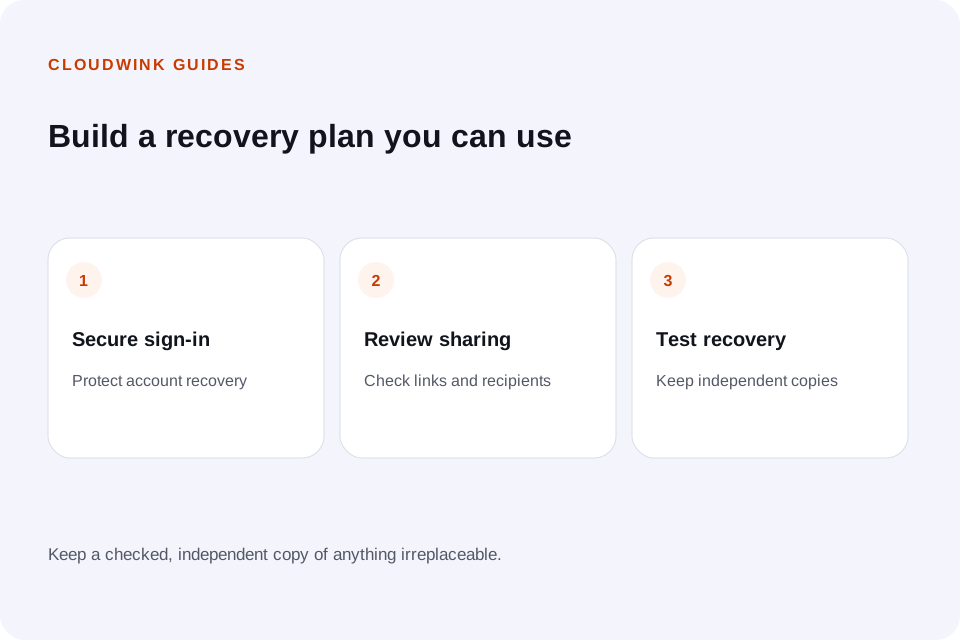
- Secure the sign-in account and recovery methods.
- Review active sharing links regularly.
- Learn retention and deletion rules.
- Check download quality and export access.
- Keep independent copies of important files.
Further reading.
Questions about this guide.
Does a private album mean nobody else can access its files?
Private means access is restricted under the service’s rules. It does not automatically mean end-to-end encryption or immunity from account compromise. Read the specific access and encryption explanations.